Last updated July 15, 2026
The Complete Guide to Gate Repair in Dallas
Dallas soil moves. Not metaphorically — literally. The Blackland Prairie clay that runs beneath most of Dallas expands up to 4 inches vertically after a heavy rain, then contracts sharply during summer drought. That single geological fact is responsible for more automatic gate misalignments, broken welds, and motor burnouts than all mechanical failures combined — yet the majority of gate repair companies who work in Dallas never bring it up. This guide explains exactly what causes Dallas gates to fail, how to match the Gate Repair services to the actual root cause, and what you can do right now to stop paying for the same problem twice.
Quick Answer
Gate repair in Dallas typically costs between $95 and $850 depending on whether the problem is an access control fault, a motor/operator issue, a hinge or hardware failure, or a structural post repair driven by soil movement. Most single-component repairs — a failed control board, a broken hinge, a misadjusted limit switch — are diagnosed and completed in one visit. Post realignment caused by expansive clay movement is more involved and requires structural assessment — see our Gate Repair Maintenance Checklist for Dallas Homeowners — before any mechanical work begins.
Table of Contents
- Why Dallas Soil Is Your Gate’s Biggest Enemy
- The Four Categories of Gate Repair (and Why Each Needs Different Skills)
- Duty Cycle Math: Why Your Motor Is Dying Faster Than It Should
- Brand-Specific Repair Considerations for the Nine Major Operators
- How to Document a Gate Failure Before the Tech Arrives
- What Gate Repair Costs in Dallas: Real Ranges by Repair Type
- Common Mistakes to Avoid
- When to Call a Professional
- Frequently Asked Questions
- The Bottom Line
Why Dallas Soil Is Your Gate’s Biggest Enemy
The Blackland Prairie formation stretches across most of Dallas County and into the surrounding suburbs. It’s a dark, calcium-rich clay that engineers call “expansive” — meaning it absorbs water and swells, then shrinks as it dries. The vertical displacement range is not trivial. During a wet spring like the kind Dallas sees in March and April, soil movement under a gate post can exceed 3 to 4 inches. In a dry August, that same soil pulls away from a post base, leaving air gaps around the concrete footer.
What this means for your gate: a post that was perfectly plumb when installed can be measurably out of vertical after one or two seasonal cycles. When the post tilts, the gate panel follows. When the gate panel shifts, the gap between the gate leaf and the strike post changes — and that gap is what your operator’s limit switches, safety loops, and hinge alignment were all calibrated to. A misaligned gate stresses every mechanical component downstream.
In neighborhoods like Lake Highlands, Lakewood, and Preston Hollow, where post-tension slab foundations are common and ornamental iron gates are often installed over original 1970s concrete work, we regularly see post displacement of 1.5 to 2 inches that has accumulated invisibly over several years. By the time the motor starts struggling or the gate scrapes the driveway, the structural cause has been building for seasons.
The fix is not just to adjust the motor’s limit switches and call it done. That approach masks the cause. The post needs to be assessed, the footer evaluated, and — if the displacement is beyond tolerance — the post reset or reinforced before any mechanical calibration is performed. That sequence matters. Skipping the structural step means you’ll be calling for the same repair within 18 months.
The Four Categories of Gate Repair (and Why Each Needs Different Skills)
Treating “gate repair” as a single service is one of the reasons Dallas homeowners end up calling a second company after the first one misses the actual problem. There are four distinct repair categories, each with a different root cause profile and a different required skill set.
1. Operator and Motor Repair
This covers the electric drive unit — the motor, gearbox, control board, capacitor, and limit switches. Failures here are usually mechanical wear, electrical surge damage, or duty cycle overload (more on that below). Proper diagnosis requires brand-specific knowledge because the control board architecture, error codes, and wiring conventions differ significantly between a LiftMaster LA500 and a FAAC 740 or a Viking SL-1000B.
2. Hinge, Roller, and Hardware Repair
Swing gate hinges, sliding gate rollers, and track hardware wear independently of the operator. A gate that binds or drags is often pulling its motor into overload — but the motor isn’t the problem, the hardware is. Replacing a motor without fixing worn rollers or seized hinges guarantees premature motor failure on the new unit.
3. Structural Post and Weld Repair
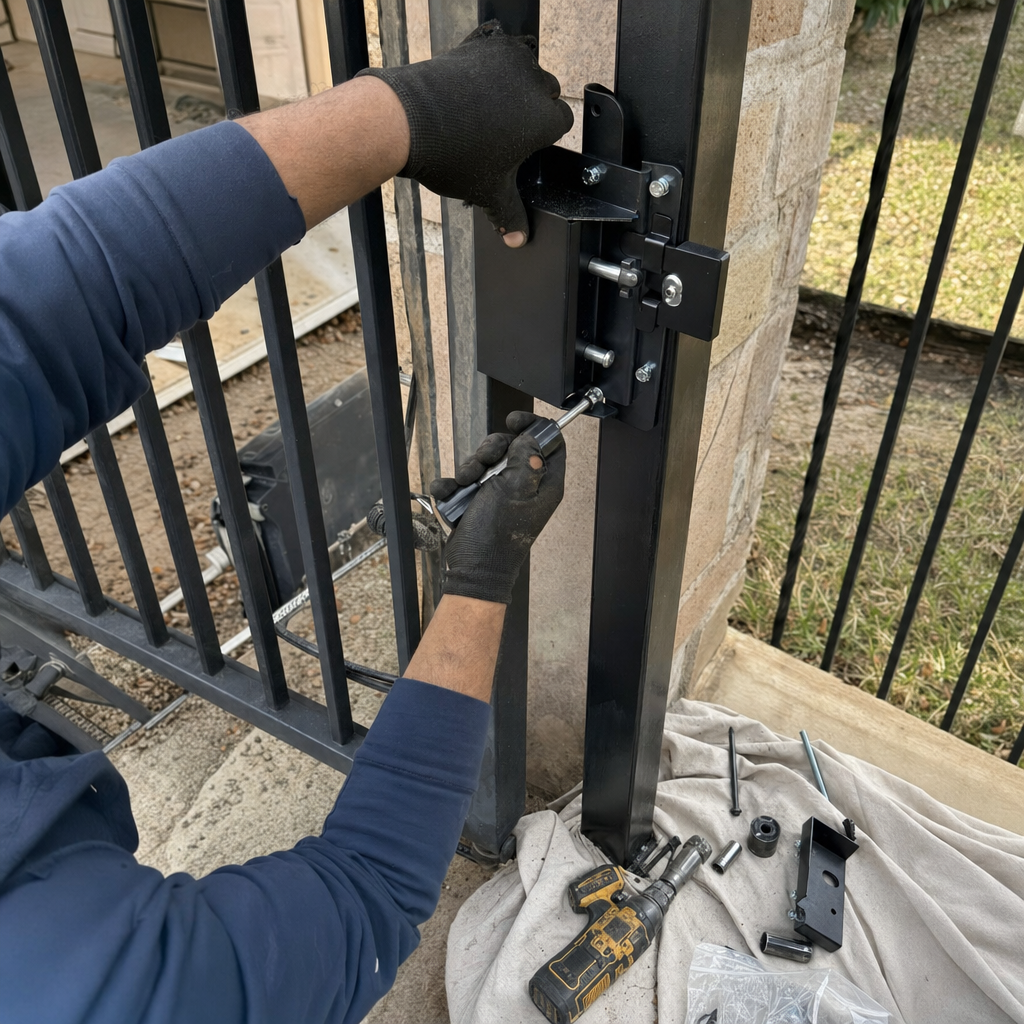
This is where in-house welding capability separates a true gate specialist from a general repair tech. Cracked welds at hinge attachment points, bent post collars, and stress fractures at the operator mounting bracket all require a welder on-site — not a referral to a metal shop. We stock material and run the welder on-site, which means structural repairs that other shops outsource get handled in the same visit.
4. Access Control and Intercom Repair
Keypads, loop detectors, intercoms, RF receivers, and smartphone access systems are a separate discipline from mechanical gate repair. A gate that won’t open from the keypad but opens fine from the remote has an access control fault, not a motor fault. These systems — particularly DoorKing intercoms, Elite keypads, and LiftMaster MyQ-integrated systems — require programming knowledge that a purely mechanical tech may not carry.
Duty Cycle Math: Why Your Motor Is Dying Faster Than It Should
Every gate operator is rated for a maximum number of open/close cycles per day. The LiftMaster LA500, one of the most widely installed swing operators in Dallas residential applications, is rated at approximately 300 cycles per day under normal operating conditions. That number sounds large — and for a single-family home averaging 8 to 12 cycles daily, it is more than adequate.
The problem surfaces on higher-traffic properties. A short-term rental property in East Dallas running 40 to 60 guest arrivals and departures per day can generate 80 to 120 operator cycles — still within spec. But a multi-tenant apartment complex in the Design District or a busy commercial lot near Uptown Dallas hitting 500 to 700 cycles per day on a residential-grade LA500 is running the motor at roughly twice its rated duty cycle. At that rate, the motor windings overheat, the capacitor degrades ahead of schedule, and the gearbox grease breaks down. An operator that should last 7 to 10 years burns out in 18 months.
The solution isn’t to keep replacing the same residential-grade unit — it’s to right-size the operator. A FAAC 740 or a BFT Igea Ultra, both rated for intensive commercial duty, handle high-cycle environments that would destroy a residential operator inside two years. Before recommending a replacement motor, Timothy assesses the actual daily cycle count against the operator’s published duty rating. That single step prevents the most avoidable repeat repair call we see in Dallas.
How to estimate your daily cycle count:
- Count the number of distinct entries and exits per day (each entry = 1 open + 1 close = 2 cycles).
- Multiply by 2 to get total operator cycles per day.
- Compare against your operator’s published duty cycle rating (find it on the data plate or in the installation manual).
- If you’re consistently running above 70% of the rated maximum, you’re in the overload risk zone.
Brand-Specific Repair Considerations for the Nine Major Operators
After 11 years working exclusively on gates across Dallas, Timothy has developed hands-on familiarity with every major operator brand in the market. Here’s what matters most from a repair standpoint for each:
- LiftMaster (LA400, LA500, CSW200): Excellent reliability at rated duty cycle. Control boards are sensitive to power surges — common during Dallas thunderstorm season. Always diagnose the board before replacing the motor. MyQ integration requires specific firmware versions to pair correctly.
- FAAC (740, 760, B614): Italian-engineered hydraulic and electromechanical units with long service lives. Hydraulic fluid level and oil condition checks are part of every FAAC service call. Parts availability requires a distributor relationship — cross-brand substitution voids the warranty.
- BFT (Igea, Phobos, Kustos): Strong performer in high-cycle commercial applications. BFT’s BUS-2 wiring protocol means accessories must be BFT-compatible — substituting a generic loop detector creates communication faults that look like motor failures.
- Linear (HySecurity, LDCO800): Workhorse commercial operators with robust documentation. Logic board error codes are well-documented; proper diagnosis requires the correct code reference for the specific firmware version installed.
- Viking (SL-1000B, 2000, Patriot): Commonly found in mid-range residential and HOA applications across Dallas. Viking’s obstruction sensing system requires periodic sensitivity calibration — especially after seasonal post movement shifts the gate travel path.
- Ghost Controls (TDS2, AXDT2): Solar-powered swing operators popular in rural-adjacent Dallas neighborhoods and properties without conduit runs. Battery bank condition is the most common failure point — not the motor itself.
- DoorKing (1812, 1816, 1830): Primarily an access control and intercom brand, but their integrated operator systems require DoorKing-specific programming tools for entry system changes. Database wipe is a risk during power interruptions.
- Elite (SW, EL25, EL50): Residential swing operators with a straightforward limit switch system. Elite’s physical limit adjustment is mechanical rather than electronic, which makes field calibration faster but also means physical wear on the adjustment screw over time.
- Mighty Mule (FM500, MM571, MM888): Entry-level residential operators common in Frisco, McKinney, and outer Dallas suburbs. Reliable at low cycle counts; not designed for properties with more than 15 to 20 daily cycles. Receiver boards are a frequent replacement item.
One point worth stating plainly: using a non-OEM part from a different brand’s parts bin to fix a warranty-covered operator voids the manufacturer warranty immediately. We stock OEM-compatible parts for all nine brands specifically to avoid that outcome.
How to Document a Gate Failure Before the Tech Arrives
The most productive service call is one where the technician walks up already knowing what the gate was doing before it stopped. Good documentation cuts a diagnostic visit from 60 minutes to 20 and sometimes reveals patterns the homeowner hadn’t connected — like a gate that only fails on mornings after overnight rain, which points directly to a soil-related alignment issue rather than an electrical fault.
Here’s what to capture before Timothy arrives:
- Video the failure in real time. Use your phone to record the gate attempting to operate. Capture the full cycle — from the command input through the gate’s response (or non-response). Show whether the motor is making sound, whether the gate moves partway, and where it stops.
- Photograph the gap and alignment. Stand at the center of the gate and photograph the gap between the gate leaf and the strike post at the top, middle, and bottom. Changes in gap width reveal post tilt or gate sag.
- Check for error codes. Most modern operators — LiftMaster, FAAC, Viking, Linear, BFT — display error codes via LED blink patterns or digital readouts. Count the blinks or photograph the display and write the code down.
- Note the failure pattern. Does it happen every cycle, or intermittently? Only in rain? Only in heat above 95°F? Only from the keypad but not the remote? These pattern details are diagnostically valuable.
- Record your approximate daily cycle count. As described in the duty cycle section above — even a rough estimate helps the technician assess whether you’re at risk of duty cycle overload.
- Locate your operator model and serial number. It’s usually on a data plate inside the motor housing or on the operator arm. Photograph it. This allows parts to be staged before arrival when the failure mode points to a likely component replacement.
Homeowners who come prepared with this information get faster repairs and spend less time waiting. It also means we can often bring the right replacement part on the first visit instead of making a parts run.
What Gate Repair Costs in Dallas: Real Ranges by Repair Type
Gate repair pricing in Dallas varies significantly by repair category, brand, and whether structural work is involved. The following ranges reflect actual market conditions in the Dallas metro area — not a national average.
| Repair Type | Typical Dallas Range | Notes |
|---|---|---|
| Diagnostic / Service Call | $75 – $120 | Usually waived or credited on repair |
| Limit switch adjustment | $95 – $160 | Often combined with alignment check |
| Control board replacement | $180 – $420 | Wide range due to brand-specific board cost |
| Motor/operator replacement | $450 – $1,400 | Depends heavily on operator grade and brand |
| Hinge replacement (per hinge) | $90 – $180 | Add welding cost if collar is cracked |
| Sliding gate roller replacement | $120 – $260 | Per roller assembly; track condition affects scope |
| Post realignment (minor) | $200 – $400 | No concrete work required |
| Post reset with new footer | $600 – $1,200 | Expansive clay sites may require caisson-depth footer |
| In-house weld repair | $150 – $350 | Done on-site; no metal shop outsourcing |
| Keypad / access control repair | $110 – $380 | Includes DoorKing, Elite, LiftMaster MyQ systems |
| Loop detector replacement | $140 – $300 | Concrete cutting may add to cost |
These are Dallas market ranges — prices vary based on parts availability, gate weight and configuration, and site conditions. Call (817) 328-3536 for a free estimate specific to your system and address.
Common Mistakes to Avoid
- Adjusting the motor limits to compensate for post movement. Widening the limit switch travel to make a shifted gate close fully is the mechanical equivalent of duct-taping the problem. The post displacement continues each season, and the gate eventually travels so far out of spec that the operator arm binds — damaging both the gate and the motor.
- Replacing the operator without diagnosing the hardware. A new LiftMaster or Viking motor bolted to a gate with worn rollers or seized hinges will fail prematurely for the same reason the original one did. The load on the new motor is identical to the load that burned out the old one.
- Using a residential-grade operator on a high-traffic property. Dallas has a significant short-term rental and multi-tenant property market. A Mighty Mule or entry-level Ghost Controls unit rated for 15 cycles per day doesn’t survive on a property logging 150. Match the operator to the duty cycle, not to the price point.
- Substituting cross-brand parts to save cost. A FAAC gate arm pin that “fits” a Viking operator may function for a few weeks and then create a liability-level failure. More importantly, it voids the manufacturer warranty on the operator immediately. OEM parts exist for a reason.
- Ignoring rust on hinge attachment welds. Dallas humidity and seasonal rain accelerate weld corrosion at hinge collars — especially on iron gates installed in the 1990s and early 2000s that are common in established neighborhoods like Kessler Park and M Streets. Surface rust that looks cosmetic is often deep corrosion undermining the structural attachment. Catch it before it becomes a gate-on-the-ground situation.
- Skipping documentation before calling for service. Calling for a repair with only “the gate stopped working” as a description means the technician arrives without the ability to pre-stage parts. Even a 60-second phone video of the failure behavior reduces diagnostic time and often eliminates a second visit for parts.
- Resetting the operator repeatedly after a fault without reading the error code. Repeated power resets after a fault code clear the log on some operators, destroying the diagnostic data. Photograph or record the error code before cycling the power.
When to Call a Professional
Some gate issues are genuinely DIY-friendly — cleaning a dirty loop detector sensor, replacing a dead battery in a Ghost Controls unit, or reprogramming a remote after a frequency reset — and our more guides & resources cover these in detail. But several failure types require a professional regardless of your mechanical ability.
Call a gate professional when:
- The gate is sagging, dragging, or visibly misaligned with the strike post — this requires structural assessment before any mechanical work.
- The operator motor runs but the gate doesn’t move, or moves erratically — a gearbox, arm, or mounting failure that carries safety risk if the gate drops unexpectedly.
- You see cracked or separated welds at hinge attachment points — a gate hanging on a compromised weld is a falling hazard.
- The control board shows an error code you can’t find in the manual, or the gate faults repeatedly after resets.
- Any access control wiring was damaged by lightning or power surge — Dallas averages over 50 thunderstorm days per year, and surge damage to DoorKing, LiftMaster MyQ, or BFT BUS-2 systems requires careful component-level diagnosis to avoid cascading failures.
Total Gate Repair Care Dallas offers free estimates across Dallas — call (817) 328-3536 and Timothy will assess your system, give you a straight answer on repair versus replacement, and tell you exactly what it will cost before any work begins.
Frequently Asked Questions
How much does gate repair cost in Dallas?
Gate repair in Dallas ranges from $95 for a simple limit switch adjustment to $1,200 or more for a full post reset with new concrete footer on an expansive clay site. The most common single-visit repairs — control board replacement, hinge replacement, roller service — run $150 to $420. Check Gate Repair Permits, Codes & Inspections in TX: What You Need to Know before scheduling major structural work. Call (817) 328-3536 for a free estimate; most jobs are quoted on-site before any work begins.
Why does my Dallas gate keep falling out of alignment?
The most likely cause is Blackland Prairie clay soil movement under your gate post. Dallas’s soil expands 3 to 4 inches vertically in wet conditions and contracts sharply in summer drought, which shifts post foundations out of plumb over seasonal cycles. Adjusting the operator limits buys time but doesn’t stop the movement — the post footer needs to be evaluated and potentially deepened or reset to stop the cycle. In neighborhoods like Lakewood, Lake Highlands, and Kessler Park, we see this pattern repeatedly.
Can you repair my gate the same day?
Most mechanical and electrical repairs — control board replacement, limit switch calibration, hinge replacement, roller service, keypad programming — are completed in a single visit because Timothy stocks parts for all nine major brands he works with. Structural post repairs that require concrete work are scheduled with appropriate curing time. Call (817) 328-3536 to describe what your gate is doing and we’ll tell you exactly what to expect before he arrives.
Is it better to repair or replace my gate operator?
Repair is almost always the right answer when the operator is less than 7 years old, the failure is a single component (board, capacitor, limit switch), and the gate hardware is in good condition. Replacement makes more sense when the motor has exceeded its duty-cycle lifespan, when repair cost exceeds 60% of replacement cost, or when you’re upgrading from a residential-grade unit to a commercial-duty operator because your property’s cycle count has grown. Timothy will give you both numbers — repair cost and replacement cost — and let you decide without pressure.
Do you work on all gate brands in Dallas?
Yes. After 11 years focused exclusively on gates, Timothy works on LiftMaster, FAAC, BFT, Linear, Viking, Ghost Controls, DoorKing, Elite, and Mighty Mule systems. Brand-specific knowledge matters because control board logic, wiring protocols, and error code systems differ significantly across these platforms. A technician who works on all of them daily diagnoses faster and avoids the cross-brand part substitutions that void warranties and cause repeat failures.
What’s the difference between a gate repair company and a general fence contractor?
A fence contractor installs and repairs fence panels and posts — that’s their primary trade. Automatic gate systems involve motor electronics, access control programming, duty cycle engineering, and structural weld repair, none of which are core skills in general fence work. Using a fence contractor for an operator fault or an access control failure is like asking a plumber to rewire an outlet — the trades are adjacent but not the same. Total Gate Repair Care Dallas works exclusively on gates; it’s the only trade Timothy has practiced for 11 years.
The Bottom Line
Gate repair in Dallas is not a single service — it’s four overlapping disciplines (operator, hardware, structural, and access control), all of which are complicated by expansive Blackland Prairie clay that physically moves your gate’s foundation across seasons. The homeowners who stop paying for repeat repairs are the ones who correctly diagnose the root cause the first time: right-size the operator to the duty cycle, assess the post before adjusting the motor, use OEM parts, and document failures before the tech arrives. With 539 verified reviews at 4.9 stars and 11 years of single-trade gate focus, Timothy Lewis and the Total Gate Repair Care team have worked through every failure pattern described in this guide — often more than once. One call, one visit, one complete fix.
Ready to Fix Your Gate?
If your gate is misaligned, stuck, throwing error codes, or simply not behaving the way it should, call (817) 328-3536 for a free estimate. Timothy handles the diagnosis himself — you won’t be talking through a call center or waiting on a crew that’s never seen your brand. Whether you’re running a LiftMaster, a FAAC, or a Viking operator, he’ll tell you exactly what’s wrong, what it costs to fix, and whether repair or replacement is the smarter call for your specific system. Estimates are free, diagnosis is thorough, and the work doesn’t leave until the gate works.
For homeowners and property managers in the broader North Texas area, we also cover gate installation and motor service in surrounding communities — including gate installation in Farmers Branch — so you’re covered across the metro, not just inside the Dallas city limits.
Written by Timothy Lewis, Owner & Lead Technician at Total Gate Repair Care Dallas, serving Dallas since 2015.