Last updated July 15, 2026
Gate Repair Permits, Codes & Inspections in TX: What You Need to Know
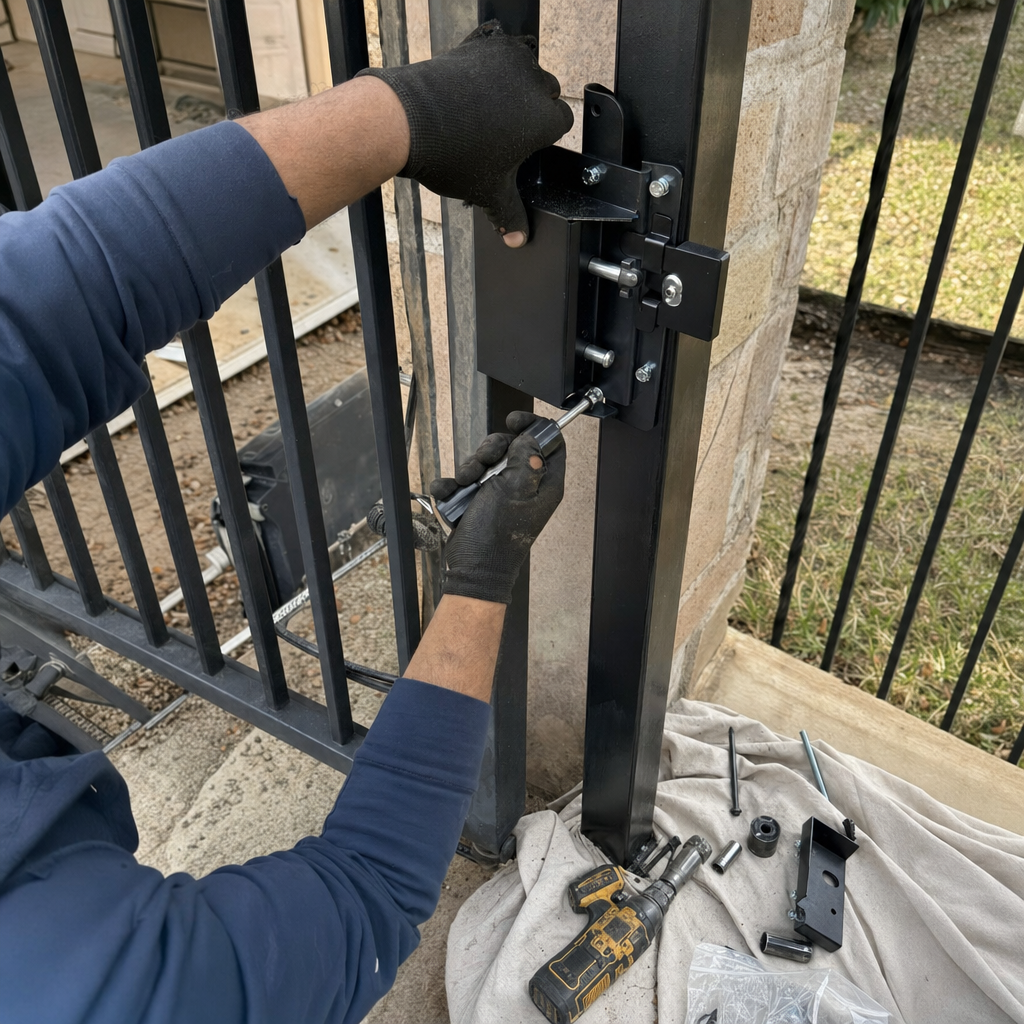
A Dallas homeowner replaced a rotting gate post last spring, poured new concrete footings, and considered the job done. Three months later, during a home sale inspection, the unpermitted structural work flagged immediately. Closing was delayed three weeks. The remediation — retroactive inspection, a licensed contractor to document the work, and city fees — ran $2,400. The original post replacement cost $600. That gap is exactly why understanding Texas gate permit rules matters, and why so many homeowners get burned: they assume permits only apply to houses, not gates. This guide walks through exactly when a permit is required in Dallas and surrounding municipalities like Farmers Branch, what UL 325 compliance means for your automatic gate system, and how to protect yourself before any work begins.
Quick Answer
Most gate repairs in Texas — lubricating hinges, adjusting sensors, replacing a gate motor — don’t require a permit. A permit is typically triggered when the work involves replacing or setting new concrete footings for gate posts, adding or modifying electrical wiring for a gate operator above 20 amperes, or physically changing the gate’s structural footprint. In Dallas and Farmers Branch, automated gate operators must also comply with UL 325 entrapment protection standards regardless of whether a permit is pulled. If you’re unsure whether your specific project crosses the threshold, call your city’s building department before work begins — not after.
Table of Contents
- What Actually Triggers a Gate Permit in Texas
- Dallas and Farmers Branch Code Requirements
- UL 325: The Safety Standard That Applies to Every Automatic Gate
- How to Check Permit History on a Property Before You Buy
- How to Get a Straight Answer from the City Before Work Begins
- When a Permit Protects the Homeowner — and When It’s Genuinely Unnecessary
- Common Mistakes to Avoid
- When to Call a Professional
- Frequently Asked Questions
- The Bottom Line
What Actually Triggers a Gate Permit in Texas
The most important thing to understand about Texas gate permits is that the trigger isn’t the repair itself — it’s whether the work touches the structure, the electrical system, or the gate’s physical footprint. This distinction trips up homeowners and contractors alike, because a gate looks like a simple object but legally it’s a combination of structural, mechanical, and electrical components, each governed by different sections of the building code.
In Texas, building permits are governed primarily at the municipal level, with cities adopting the International Building Code (IBC) or International Residential Code (IRC) as their base. Here’s a practical breakdown of what crosses the permit threshold and what doesn’t:
Work that typically does NOT require a permit:
- Replacing a gate motor or opener (like swapping one LiftMaster unit for another of equivalent amperage)
- Lubricating, adjusting, or replacing hinges, rollers, and track hardware
- Repairing or replacing safety sensors (photo eyes, edge sensors)
- Programming access control keypads or intercoms
- Repainting or refinishing gate surfaces
- Replacing broken welds on existing gate panels without altering dimensions
Work that typically DOES require a permit:
- Replacing a gate post when the repair requires setting new concrete footings (this is structural work)
- Adding a new electrical circuit or wiring for a gate operator that draws more than 20 amperes
- Widening or extending a gate opening — any change to the gate’s physical footprint
- Installing a new automated gate system where no gate previously existed
- Relocating an existing gate to a different position along the fence line
The footing rule catches the most homeowners off guard. In Texas’s expansive clay soils — especially prevalent across the Dallas metro — posts can heave, lean, and crack footings within five to seven years. Replacing a damaged post feels like a maintenance task, but the moment you’re digging and pouring concrete, most municipalities classify it as structural work requiring a permit and inspection.
Dallas and Farmers Branch Code Requirements
Dallas and Farmers Branch each administer their own building departments, and while both adopt versions of the IBC and IRC, there are local amendments worth knowing.
City of Dallas
Dallas adopts the IBC and IRC with local amendments managed through the Dallas Development Services Department. For residential automated gate installations, the relevant triggers are structural (footing work, post replacement), electrical (anything over 20A requiring a circuit permit and licensed electrician), and any new installation or relocation. Dallas also enforces fence and gate height limits in residential zones — typically 8 feet maximum in rear yards and 4 feet in front yards — so any gate replacement that changes the height needs zoning review in addition to a building permit.
Dallas Development Services operates an online permitting portal where you can apply for a permit, schedule an inspection, and track status. For gate-specific projects, you’ll typically need a building permit (structural work) and a separate electrical permit (wiring), each inspected independently.
City of Farmers Branch
Farmers Branch enforces gate and fence regulations through its Community Development Department. The city follows the IBC with local amendments and has specific language around automated gate operators in residential settings. Key Farmers Branch requirements for automated gates include:
- Entrapment protection: All automated gates must comply with UL 325 (covered in detail in the next section). This is not optional — it applies to new installations and to any existing gate where the operator is replaced or upgraded.
- Clearance zones: Swing gates must maintain a 2-foot clear zone on the non-hinge side during operation, and slide gates must have a clear zone at the leading edge equal to the gate’s travel path plus 2 feet. Obstructions — vehicles, landscaping, utility boxes — within these zones must be addressed before an operator is installed.
- Edge sensor requirements: Farmers Branch code (consistent with UL 325 for Class II residential automated gates) requires that swing gates over 100 lbs or slide gates over 50 lbs be equipped with a contact-type edge sensor or a non-contact equivalent (such as a photoelectric sensor array) on the leading edge.
- Electrical: Any new 120V or 240V circuit for a gate operator requires an electrical permit and licensed electrician inspection.
If you’re dealing with a gate in Gate Repair in Farmers Branch, these requirements apply from the moment a new operator is installed — even if you’re simply replacing an old one that was already there.
UL 325: The Safety Standard That Applies to Every Automatic Gate
UL 325 is the Underwriters Laboratories standard for door, drapery, gate, louver, and window operators and systems. For residential and commercial automatic gates, it’s the defining safety framework — and it applies to every automated gate installation in the United States, regardless of whether a permit is required for your specific project.
Understanding UL 325 starts with knowing how gates are classified:
- Class I: Residential — single-family homes, individual garage/gate access
- Class II: Multi-family or commercial — used by the general public, up to 25 mph vehicle speed permitted for access
- Class III: Industrial/limited access — restricts access to authorized vehicles only
- Class IV: Restricted access — guard-attended facilities, no unauthorized entry
For most Dallas-area homeowners, your automatic gate is a Class I or Class II installation. Here’s what UL 325 requires for those classes:
- Entrapment protection: Every automated gate operator must have at least one form of entrapment protection — contact sensors (edge sensors), non-contact sensors (photo eyes), or both. A single photo eye at vehicle height doesn’t satisfy UL 325 for pedestrian entrapment protection in Class II gates.
- Obstruction reversal: The operator must detect an obstruction and reverse direction within a specified force and distance threshold. Operators that push through resistance rather than reversing are non-compliant.
- Gate speed limits: For Class I and II slide gates, the leading edge must not exceed 1 foot per second in the travel zone within 6 inches of a stop. Swing gates must not exceed 2 feet per second at the leading edge.
- Warning label placement: UL 325-compliant operators must be installed with warning labels visible from both sides of the gate — commonly the instruction placard that comes with LiftMaster, FAAC, BFT, or Linear units.
- Manual release: Every operator must include an accessible manual release that allows the gate to be operated by hand in case of power loss or malfunction.
What makes an installation non-compliant? In our experience across Dallas and surrounding areas, the most common UL 325 violations we encounter on existing systems are: missing or failed edge sensors, photo eyes positioned only at vehicle bumper height (missing pedestrian zone), operators that have had the obstruction reversal sensitivity adjusted down to the point of non-compliance, and gates where prior repairs removed or bypassed safety sensors that were never restored.
Brands like LiftMaster, FAAC, BFT, Viking, and Ghost Controls ship UL 325-compliant operators from the factory. But a compliant operator installed without the required sensors doesn’t make the overall system compliant. The operator and the entrapment protection devices together constitute the “system” under UL 325.
How to Check Permit History on a Property Before You Buy
Checking permit history before purchasing a property with an existing automatic gate is one of the most underutilized steps in Texas real estate due diligence — and one of the most valuable. Here’s a step-by-step process for Dallas and Farmers Branch properties:
- Identify the permitting jurisdiction. Look up the property address to confirm whether it falls under City of Dallas, Farmers Branch, or another municipality. City boundaries in the Dallas metro aren’t always intuitive — some neighborhoods that feel like “Dallas” addresses are actually incorporated into Farmers Branch or another suburb.
- Access the city’s online permit portal.
- Dallas: Use the Dallas Development Services ePlan portal (accessible via the city’s official development services website). Search by address for all permits on record.
- Farmers Branch: The Community Development Department maintains permit records searchable by address. Call (972) 919-2500 if online records aren’t available for older permits.
- Search by address, not by permit type. Automated gate permits are often filed under “fence,” “electrical,” or “miscellaneous structure” rather than a dedicated “gate” category. Review all permits on record, not just ones with “gate” in the description.
- Look for a Certificate of Occupancy or final inspection sign-off. A permit pulled but never finaled (meaning the inspection was never completed and passed) is often worse than no permit at all — it signals work that may have started but wasn’t completed to code.
- Request records for electrical permits separately. Gate operator wiring is often permitted under a separate electrical permit. Cross-reference structural and electrical records to make sure both exist if the gate has an automated operator.
- If no records exist for a clearly automated gate, ask the seller directly. Request documentation of the installation. If none exists, price the cost of a retroactive inspection or system upgrade into your offer — or require the seller to bring it to code before closing.
We’ve seen situations in Dallas-area home sales — particularly in neighborhoods like Preston Hollow, Lakewood, and the areas around the Farmers Branch industrial corridor — where buyers assumed the gate was “grandfathered” only to discover it was never permitted and didn’t meet UL 325 requirements. Grandfathering in Texas applies narrowly and generally doesn’t protect unpermitted work from disclosure obligations or code enforcement during a sale.
How to Get a Straight Answer from the City Before Work Begins
The single best thing you can do before any gate work that might require a permit is call the city’s building department — not a contractor, not a neighbor, the city. Here’s how to get a useful answer rather than a runaround:
- Call the permit counter directly with your address and a plain-language description of the work. Say: “I need to replace a gate post that requires new concrete footings and install a new LiftMaster slide gate operator. Do I need a permit, and if so, which type?” Specific questions get specific answers.
- Ask whether a homeowner can pull the permit or whether a licensed contractor is required. In Texas, homeowners can pull building permits for work on their own primary residence in most municipalities. But electrical permits almost always require a licensed electrician — the homeowner exemption typically doesn’t extend to electrical work.
- Ask about the inspection process. Will a structural inspection be required after the footing is poured but before it’s backfilled? Will an electrical inspection be required before the operator is energized? Knowing the inspection sequence prevents you from covering work that needs to be inspected in the open.
- Get the scope documented. Ask for the permit application number and any notes from your call to be logged. If there’s a dispute later, having a record that you asked protects you.
- For Farmers Branch specifically: Ask whether the project requires a zoning review in addition to the building permit. Farmers Branch has active code enforcement, and gate projects near front property lines can trigger a separate review under the city’s fence and wall ordinance.
If the city’s answer still isn’t clear, a gate specialist who has worked in that municipality can often help you frame the question correctly. After 11 years handling gate projects across Dallas and surrounding cities, Timothy Lewis has navigated this process enough times — including how to hire a gate repair contractor in Dallas — to know which questions get the right answers on the first call.
When a Permit Protects the Homeowner — and When It’s Genuinely Unnecessary
Permits have a real cost — the filing fee, the wait time, the inspection scheduling — and it’s fair to ask whether they’re worth it in every case. The honest answer is: sometimes a permit genuinely protects you, and sometimes for routine gate maintenance it’s an unnecessary layer for work that’s clearly below the threshold.
When a permit actively protects you:
- Home sale disclosure: In Texas, unpermitted work that required a permit must be disclosed in a real estate transaction. A permit and final inspection sign-off means there’s no disclosure issue and no negotiating chip for the buyer to use against you.
- Insurance claims: If a gate collapses and injures someone, your homeowner’s insurance will investigate whether the installation was code-compliant. Unpermitted work that didn’t meet code can void coverage.
- Structural confidence: A required inspection means a city inspector verified the footings were set correctly. In Dallas’s expansive clay soils, improperly set footings can fail within a few years — an inspection catches problems before the concrete is poured and buried.
- Contractor accountability: If a contractor pulls a permit and the work fails inspection, the contractor is on record and responsible. Work done without a required permit has no such paper trail.
When a permit is genuinely not required:
- Replacing a gate motor (same amperage, same circuit, no new wiring) — this is maintenance, not construction
- Adjusting, lubricating, or replacing mechanical hardware (hinges, rollers, chains)
- Repairing or replacing safety sensors and access control devices
- Welding a cracked gate panel in place without altering dimensions or moving the gate
For Gate Installation in Farmers Branch, particularly new automated systems where no gate existed before, a permit is almost always required and worth the process. For a motor swap on an existing system with no wiring changes, it’s genuinely unnecessary — and a contractor telling you otherwise for routine motor work should raise a question about why.
Common Mistakes to Avoid
- Assuming “repair” means no permit required. The word repair doesn’t determine permit status — the nature of the work does. Replacing a gate post with new concrete footings is structural work regardless of what word you use to describe it, and in Dallas and Farmers Branch it requires a permit.
- Letting a contractor start work without pulling the permit first. A permit must be obtained before work begins, not after. Retroactive permitting (also called “after-the-fact” permitting) is possible in some Texas cities but typically costs 2–3 times the normal permit fee and may require destructive inspection of covered work.
- Assuming UL 325 compliance is automatic when a new operator is installed. A UL 325-listed operator installed without the required entrapment protection sensors doesn’t make the system compliant. We regularly encounter swing gates in Dallas-area HOA communities where the operator was replaced but the edge sensors were never connected to the new unit.
- Confusing zoning approval with a building permit. These are separate approvals in Dallas and Farmers Branch. A gate that exceeds the height limit for its zone needs zoning approval (or a variance) independent of the building permit. Skipping zoning review can result in a stop-work order even on a properly permitted project.
- Not checking permit history before a home purchase. Automated gate systems are easy to inspect visually but the permit history lives in city records. An existing gate that looks fine and operates fine may have been installed without a permit — which becomes your problem the moment you close on the property.
- Relying on the “it’s always been that way” defense. Texas grandfathering provisions are narrow and don’t generally protect work that required a permit but never received one. Code enforcement during a home sale or after a complaint isn’t blocked by how long the gate has been there.
- Hiring a general contractor for gate-specific code compliance. Gate operators, entrapment protection, and UL 325 requirements are specific enough that a general contractor who handles gates occasionally may not know the edge sensor requirements or the clearance zone specifics for Farmers Branch. This isn’t a criticism of general contractors — it’s a specialization argument. Gate code compliance benefits from someone who works this code every day.
When to Call a Professional
Call a gate specialist rather than attempting DIY when: the work involves any electrical component beyond a straightforward battery replacement or sensor alignment; you’re replacing a post and need to assess whether new footings are required (and how to do it correctly in Dallas’s clay soil conditions — see our seasonal gate repair care for Dallas guide); your gate operator is failing but you’re not sure whether the problem is mechanical, electrical, or a UL 325 sensor fault; or you’ve purchased a property and need a professional assessment of whether the existing gate system meets current code before you invest further.
For new Gate Motor & Opener in Farmers Branch installations specifically, the combination of permit requirements, UL 325 entrapment protection, and clearance zone compliance is detailed enough that an experienced specialist who works these systems daily is the right call.
Timothy Lewis at Total Gate Repair Care Dallas has 11 years of gate-specific experience across brands including LiftMaster, FAAC, BFT, Viking, Ghost Controls, DoorKing, Elite, Linear, and Mighty Mule — and handles jobs personally. Call (817) 328-3536 for a free estimate. We’ll assess what your project requires, whether a permit applies, and handle the technical work correctly the first time.
Frequently Asked Questions
Do I need a permit to replace a gate motor in Texas?
No — in most Texas municipalities including Dallas and Farmers Branch, replacing a gate motor or operator on an existing circuit with no wiring changes doesn’t require a permit. The work is classified as maintenance, not construction. However, if the replacement requires adding a new circuit, upgrading to a higher-amperage service, or running new conduit, a separate electrical permit is required. Call (817) 328-3536 if you’re unsure what your specific swap involves — we’ll give you a straight answer before we touch anything.
What is UL 325 and do I have to comply with it in Dallas?
UL 325 is the Underwriters Laboratories safety standard for automated gate operators — it defines entrapment protection requirements, gate speed limits, and sensor requirements for residential and commercial systems. In Dallas and across Texas, any automated gate installation or operator replacement is expected to comply with UL 325 regardless of whether a permit is pulled. A non-compliant system — one without functioning edge sensors or with disabled obstruction reversal — creates liability exposure for the homeowner. Call (817) 328-3536 if you want a UL 325 compliance check on your existing system.
Can I pull a gate permit myself as a homeowner in Texas?
Yes, in most Texas municipalities homeowners can pull building permits for structural work (like footing replacement) on their primary residence without a contractor license. The exception is electrical permits — virtually every Texas city requires a licensed electrician to pull and complete electrical permits, so the wiring for your gate operator’s circuit needs a licensed electrician regardless of who does the mechanical work. Confirm the specific rules with your city’s permit counter before starting.
How do I check if a gate was properly permitted in Dallas before I buy a home?
Search the Dallas Development Services ePlan portal by the property address and look at all permits on file — gate permits may be filed under “fence,” “electrical,” or “miscellaneous structure.” For Farmers Branch, contact the Community Development Department directly. Look specifically for a final inspection sign-off, not just a permit number — a permit pulled but never finaled indicates work that may not have been completed to code. If no records exist for an obviously automated system, treat that as a negotiating point or require remediation before closing.
What happens if a gate is installed without a required permit in Texas?
Unpermitted work that required a permit creates several problems in Texas: it must be disclosed in a real estate transaction, it can void homeowner’s insurance coverage for related claims, and it can be subject to city code enforcement action requiring the work to be brought to code at the owner’s expense. Retroactive permitting is possible in Dallas and most surrounding cities but typically costs 2–3 times the standard permit fee and may require a code official to inspect — or demolish and redo — covered work to verify compliance.
Does Farmers Branch have specific requirements for automated gate safety sensors?
Yes. Farmers Branch follows UL 325 requirements for automated gate entrapment protection, which for Class I and Class II residential gates means contact-type edge sensors or a non-contact equivalent (such as a photoelectric sensor array) on the leading edge of any gate over the weight thresholds — 100 lbs for swing gates, 50 lbs for slide gates. A single photo eye at vehicle bumper height doesn’t satisfy the pedestrian entrapment requirement under UL 325. When we install or replace an operator in Farmers Branch, UL 325 sensor compliance is part of every job — it’s not optional. Call (817) 328-3536 with questions about your specific system.
The Bottom Line
Texas gate permits aren’t triggered by the word “repair” — they’re triggered by the nature of the work. For more guides & resources on gate maintenance and compliance, explore our blog. Concrete footings, new electrical circuits, and structural changes require permits in Dallas and Farmers Branch. Routine motor swaps, sensor replacements, and mechanical adjustments generally don’t. Every automated gate system — permitted or not — must comply with UL 325’s entrapment protection requirements. Checking permit history before buying a property with an existing gate is straightforward and worth doing. And when a project does cross the permit threshold, the smartest move is to get it right the first time: the $2,400 remediation story at the top of this guide is a real outcome, not a hypothetical.
Written by Timothy Lewis, Owner & Lead Technician at Total Gate Repair Care Dallas, serving Dallas since 2015.